Sunday, June 14, 2015

The Resonant World, The Shuddering World


Poets have a choice: to keep their poems and books circumscribed by the limits of humanity and the charmed circle of the human, or to include what Keats and the other major Romantics sought to include in their poetry, what I call the resonant world, the shuddering world. The resonant world textual model seeks to include the idea that living energies which surround humanity, but are not strictly human, energies which inhabit forests, skies, mountains, trees, bodies of water, and the like, effect in an interstitial way human consciousness so that the human brain, and all its byproducts, benefits from exposure to and interaction with these elements. Human consciousness resonates with, and shudders in response to, these interactions, which not only stimulate but consummate the human imagination, as in Shelley's Mont Blanc.

Resonant world and shuddering world energies were not favored in twentieth century literature. Modernism and (even more extremely) post-modernism made a point of emphasizing the deadness, superficiality, and illusory nature of resonant world or shuddering world textual connections. By remaining within humanity's charmed circle and ascribing adolescent immaturity to any attempted chiasmus, made in an emotionally earnest way, with nature, Modernism and its own byproducts shut down Romanticism's enterprise most self-consciously, and with an attempt to make this shut-down permanent. If I want to re-open the issue in 2015, it is because the question of human susceptibility to energy sources past the merely human is both too stimulating and too fascinating to let go of permanently, as the Mod and po-mo cognescenti so hoped.

Saturday, June 13, 2015

YUDU2


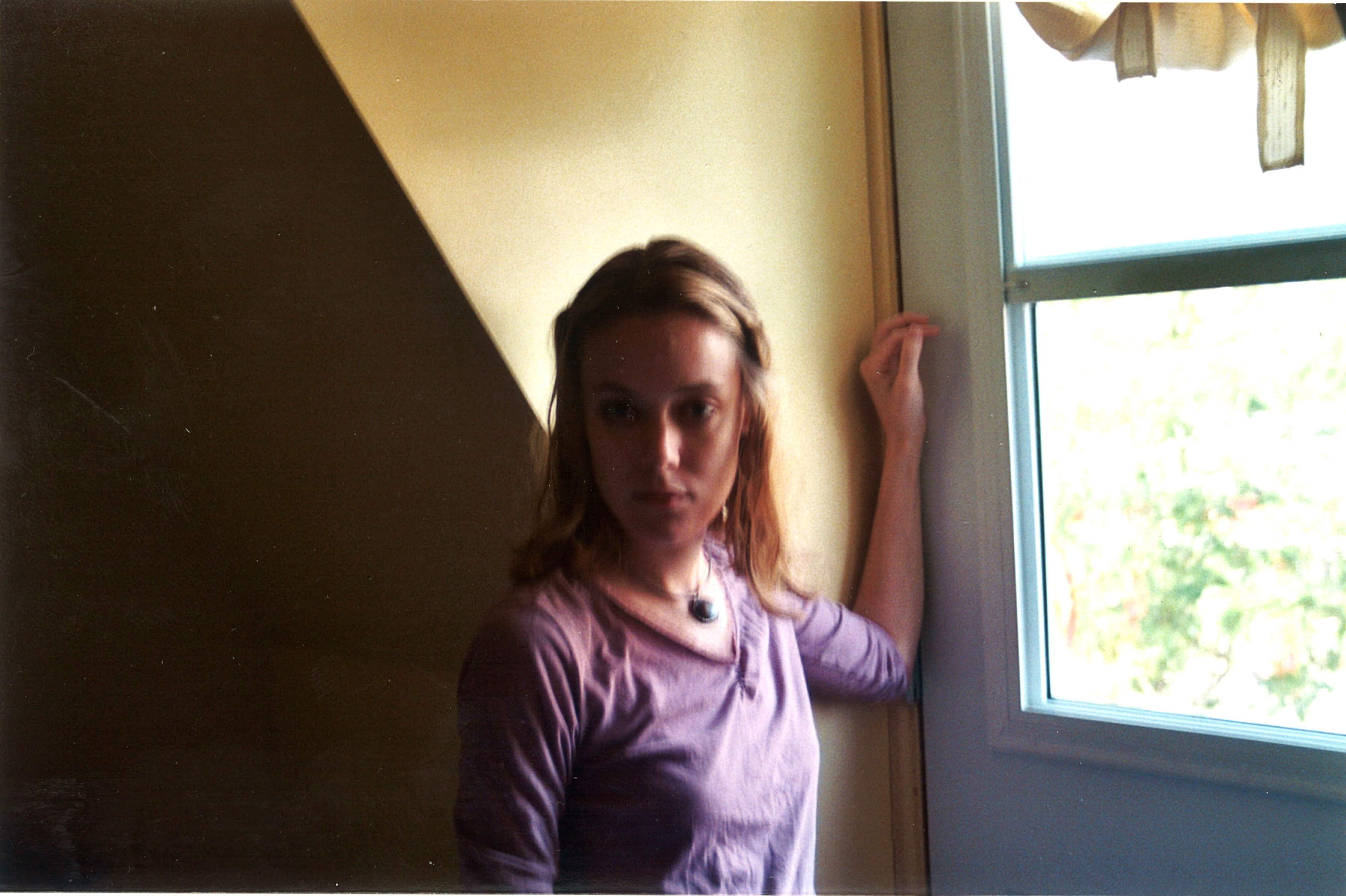
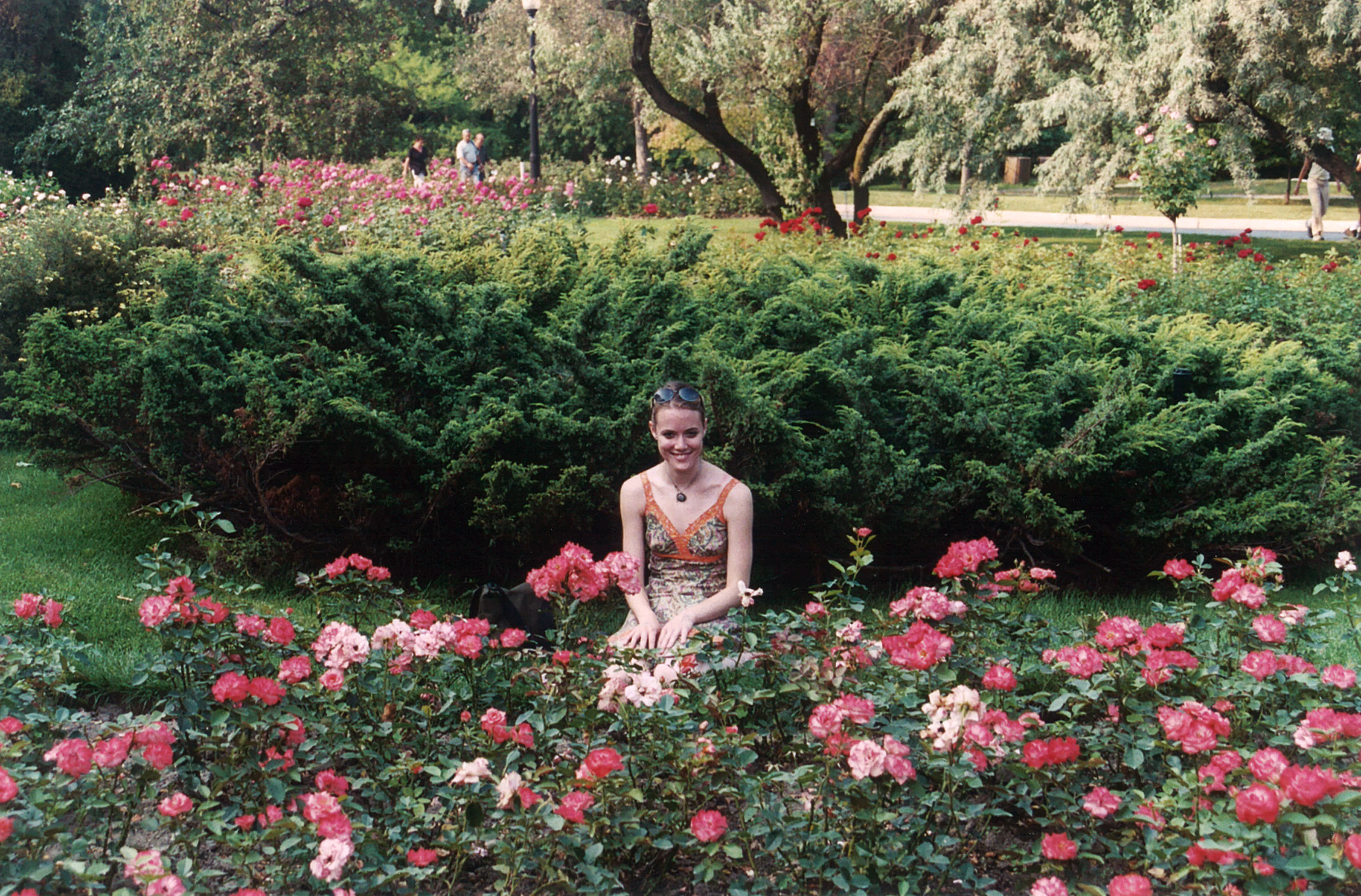
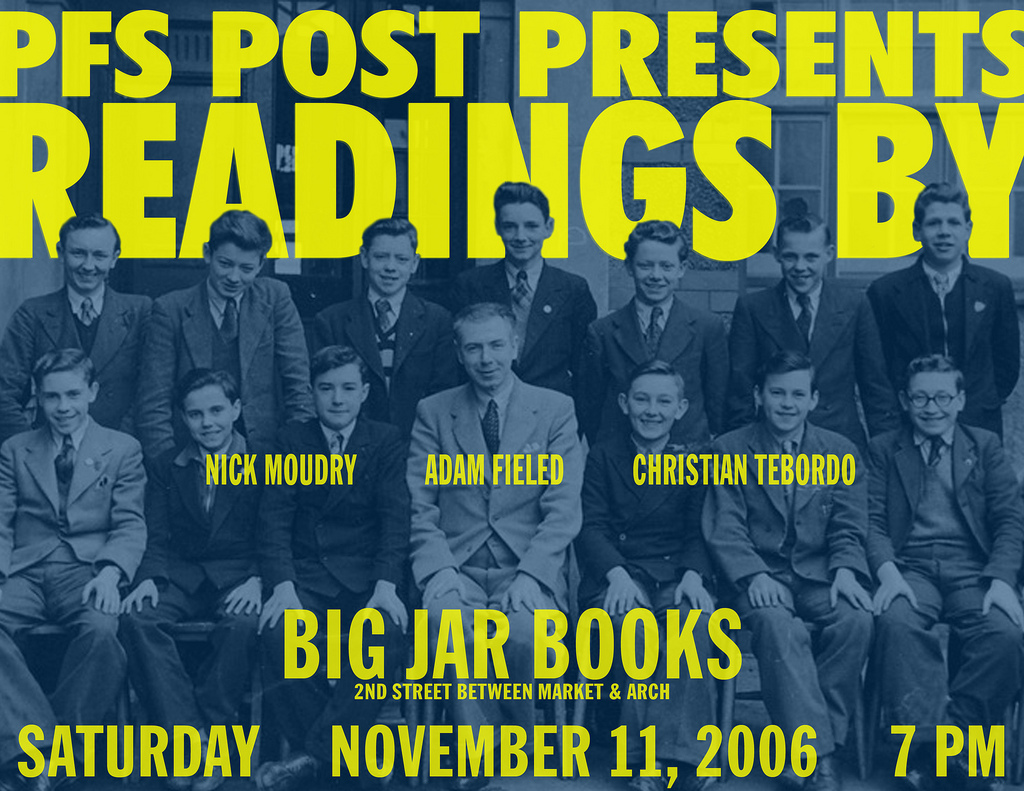
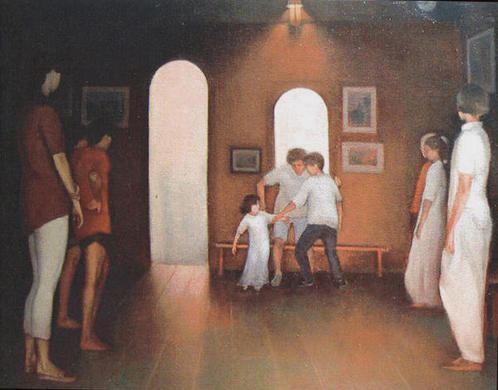
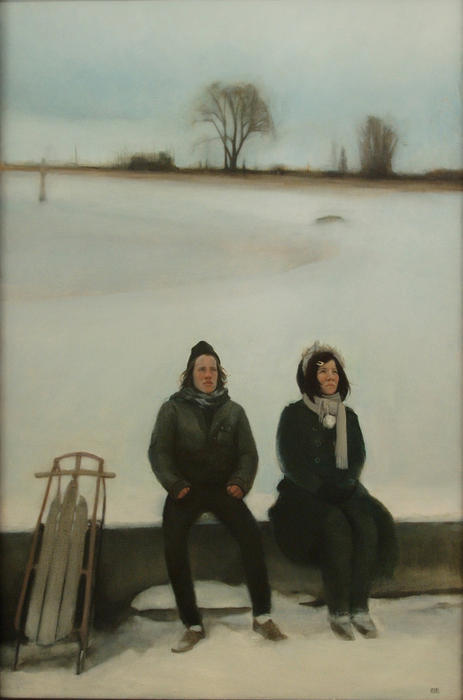
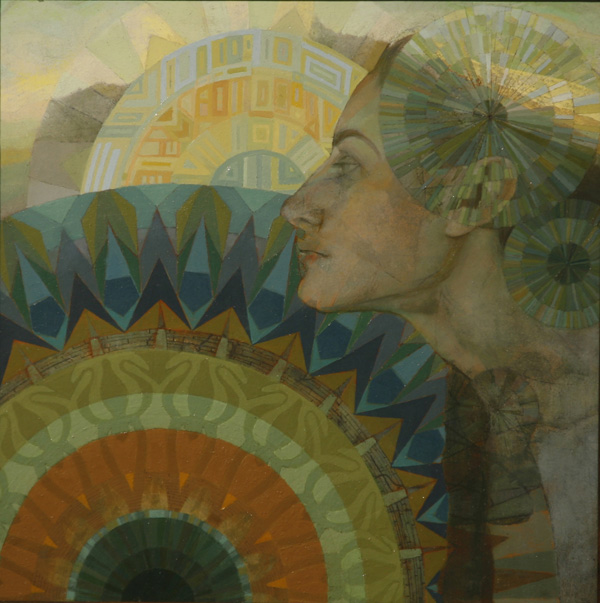
More YUDU chiasmus work: Mary In Montreal 1 (Hotel Room), 2 (Botanical Gardens), Toiling in Obscurity, Big Jar Books, Learning to Dance, Frozen Warnings.

Euphoria and Form: Ingres/Keats


The better part of two centuries has gone by: has anyone dared to do a substantial critical chiasmus between English Romanticism and French Neo-Classicism? The vision (for instance) of Ingres's Odalisque with Keats' odal Psyche- for me, it has to do with euphoria generated from the apotheosis of aesthetic formality or (if you will) formalism- the most perfect possible artistic forms (Keats' prosody, Ingres's color harmonies and uniquely postured Muse), which innovate and conserve so seamlessly (Greece to England, Greece to Frannce) that what is ecstatic or euphoric in the consciousness of the viewer or reader is the realization of possibilities of "universe structures." That intended effect of aesthetic beauty, of form, lost/corroded in the twentieth century via the perceived desirability of aesthetic hovels (irony precluding euphoria), is shared by the erotics of Keats/Ingres in such a way that, as they reach backwards to the classical and forwards to us, we may understand why the twentieth century lost its sense of possible ecstasy/euphoria in its myopic insistence on "singular time."

Friday, June 12, 2015

The YUDU Chiasmus


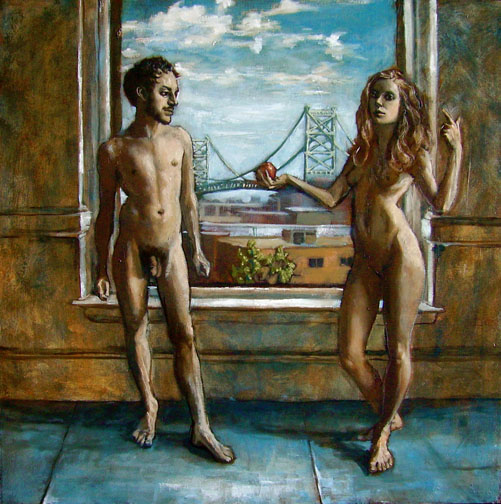
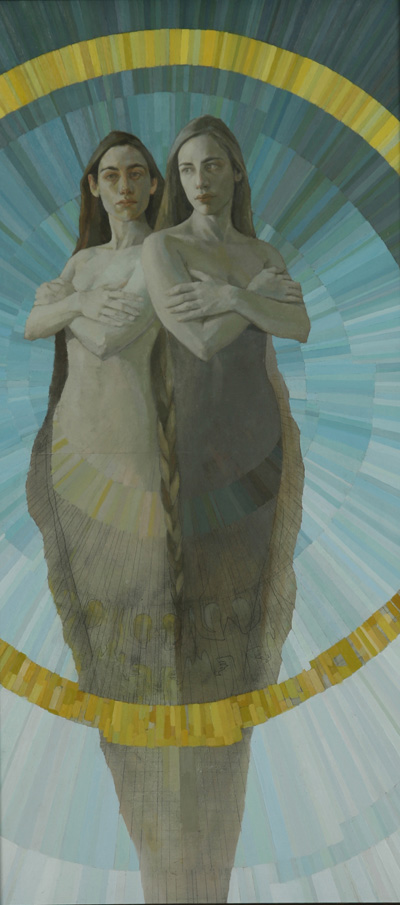
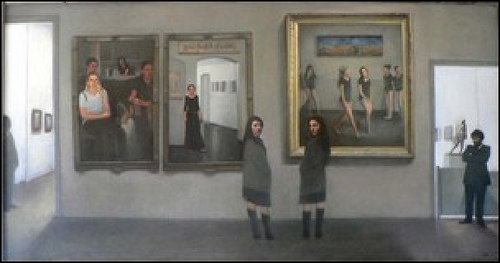
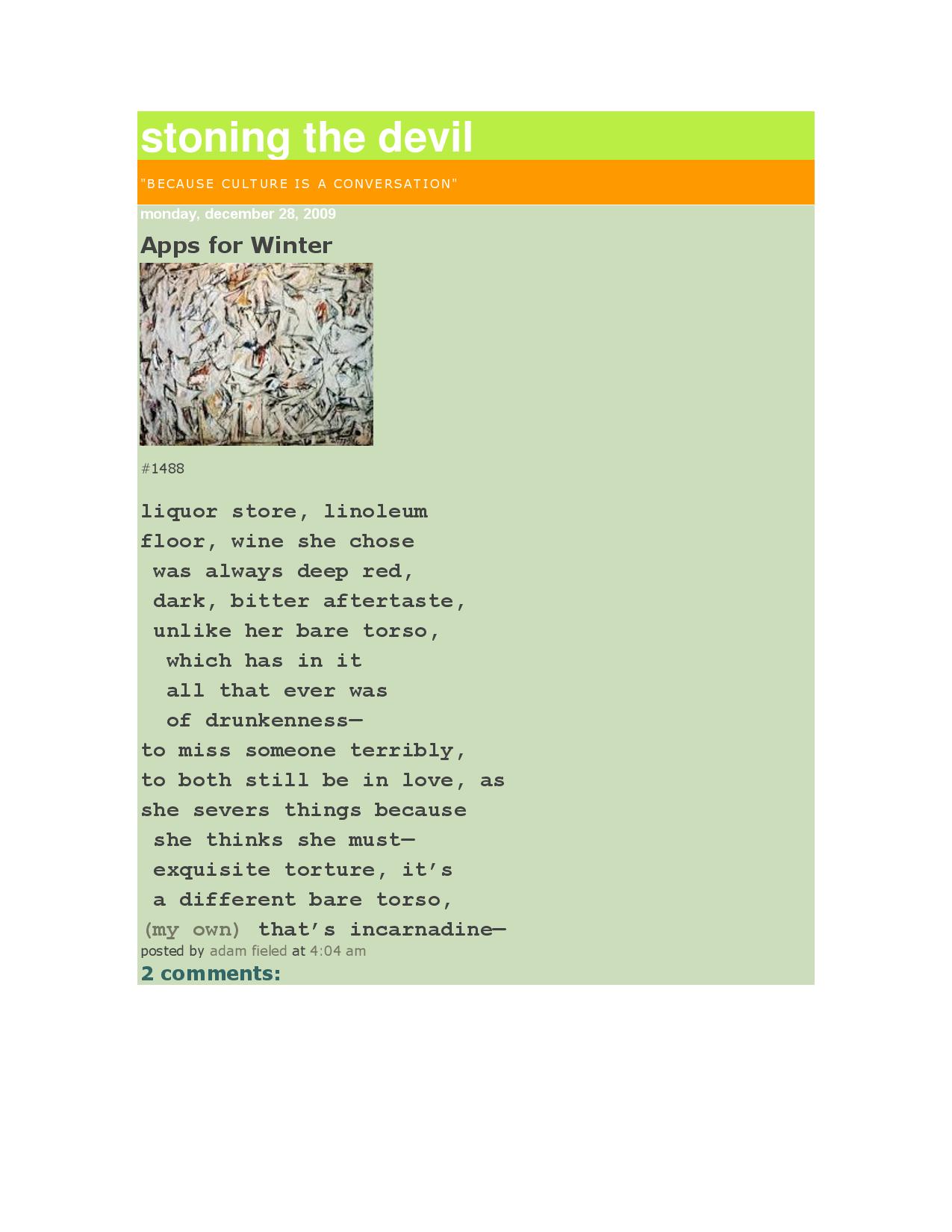
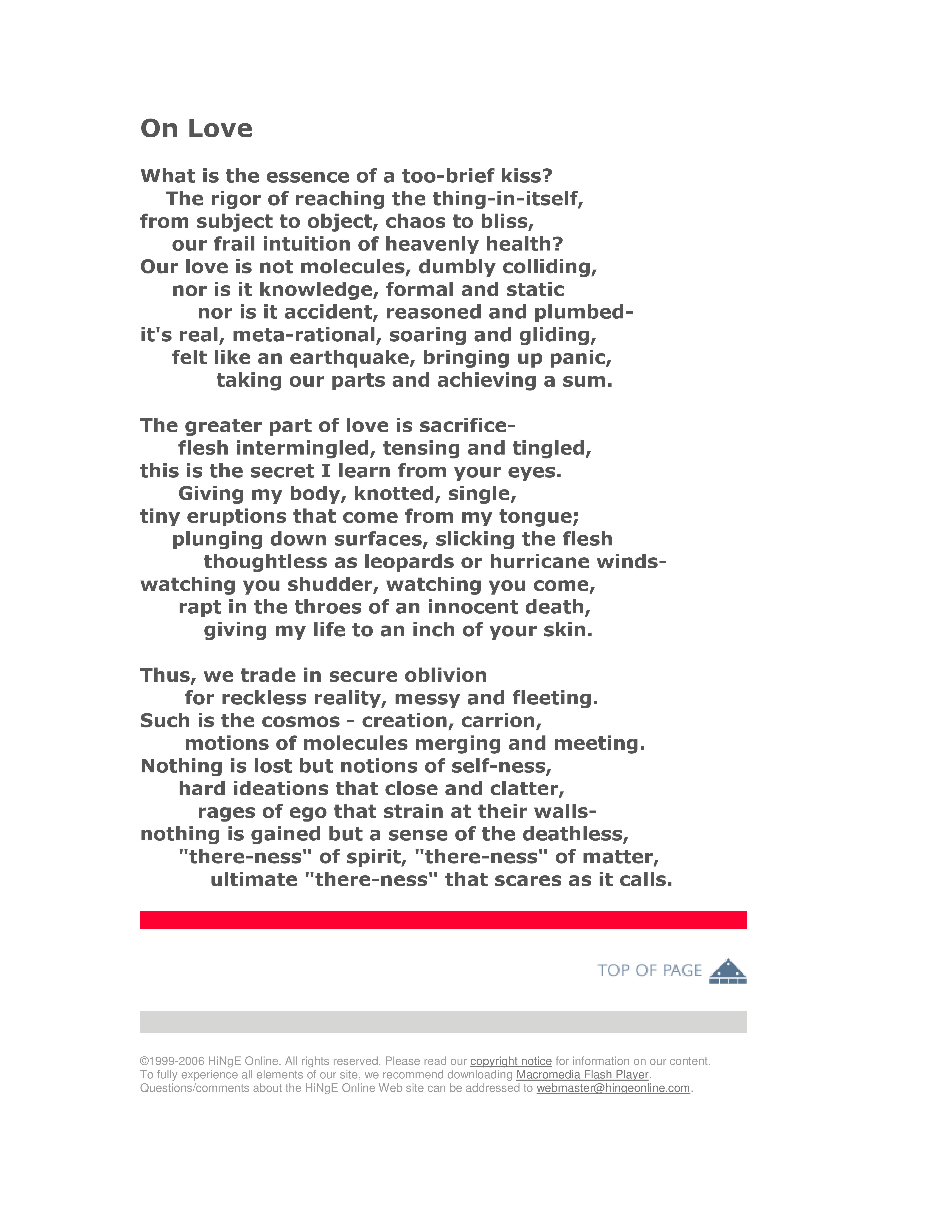
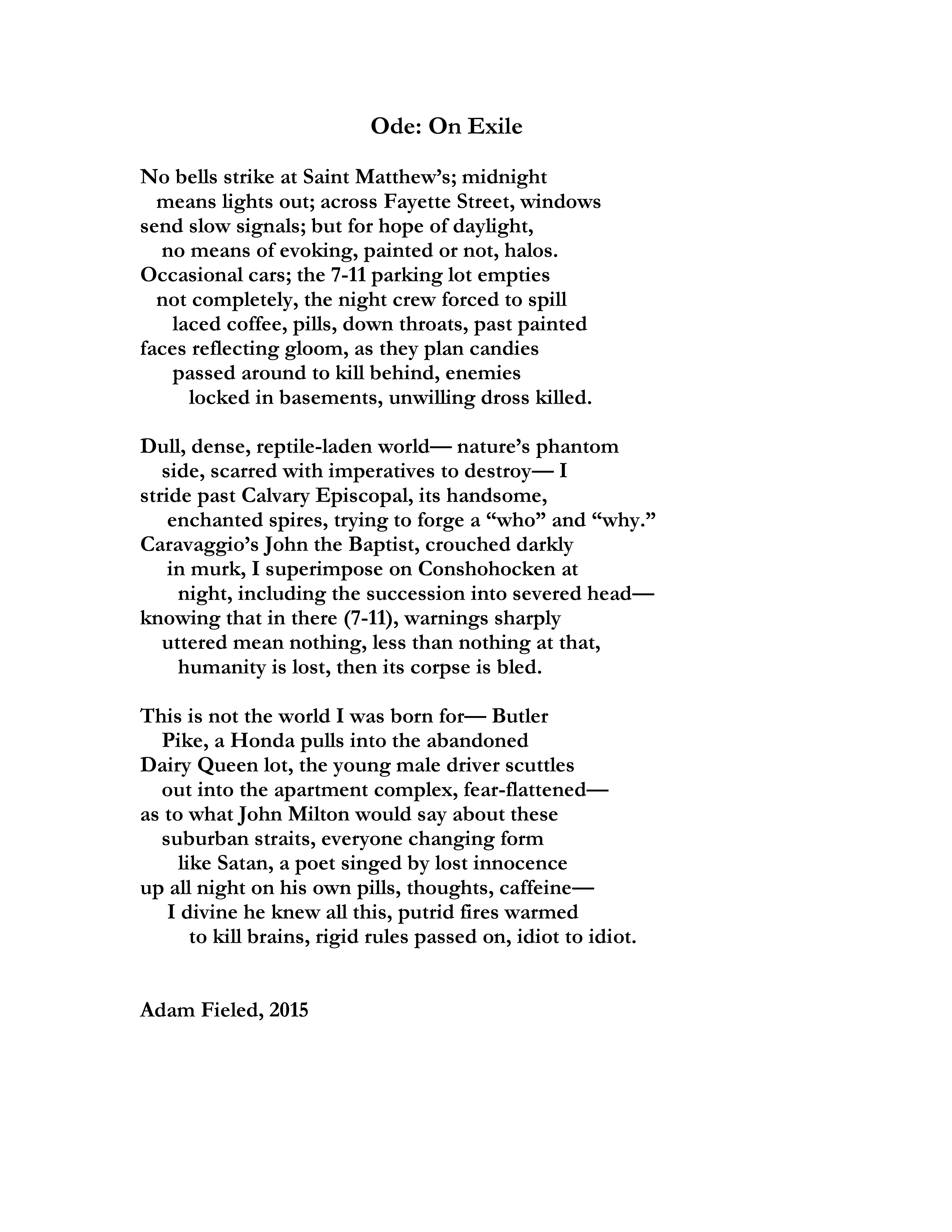
If the Lost Twins found themselves in the YUDU gallery, here's what they might find of ours: The Fall, Meeting Halfway, Ghost of Day, The Lost Twins, Cheltenham (Book Cover), App 1488, On Love, On Exile, Self-Portrait: The Vessel.

The Prosody: Ecstasy/Ecstasy


The quirk which inheres in John Keats' prosody- that it is a kind of representation or enactment of ecstatic states of consciousness, or euphoria- is balanced, in some of the Odes, especially Nightingale and Grecian Urn, by the appearance, within the consciousness of the protagonist, of the second meaning of "ecstasy" in the nineteenth century or back- the circumstance by which a person transcends their own skin, into dementia or madness, past the limitations of the physical. That's why the magnificence of Keats' prosody, its euphoric "ecstasy," can work for or against the narrative-thematic gist of what is being imparted, especially when the other, foreboding side of "ecstasy" is being investigated. Here, the prosodic heft of Keats' language has a phallic quality of triumphant euphoria:

What leaf-fringed legend haunts about thy shape
Of deities or mortals, or of both,
In Tempe or the dales of Arcady?
What men or gods are these? What maidens loth?
What mad pursuit? What struggle to escape?
What pipes and timbrels? What wild ecstasy?


But in Nightingale, the two strains of ecstasy chafe against each other in such a way that "ecstasy" and its doppelganger are at loggerheads. Why this is interesting is that once Keats' prosodic superiority to the entire English-language canon is established, we may start to look at his music and how it functions within itself, both in relation to narrative-thematic elements and in relation to the structural semantic and syntactic elements which configure it as a self-sufficient linguistic system.

Thursday, June 11, 2015

Are Keats' Minor Sonnets Send-Ups?


Twentieth century master narratives around British Romanticism, I predict, may come to look stifled and jejune in the twenty-first century. One of the (if less cherished) myths around this body of work is that Keats' minor sonnets, all written in the nineteenth century Teens, express sentiments without undue irony, and with an inhering spirit of earnestness and naive appreciation of Keats' young life, of literature, and of the social circle around the three Keats brothers. Keats, we were told in century XX, was not being coy when he wrote this (for instance) about painter Benjamin Robert Haydon:

Highmindedness, a jealousy for good,
A loving-kindness for the great man's fame,
Dwells here and there with people of no name,
In noisome alley, and in pathless wood:
And where we think the truth least understood,
Oft may be found a "singleness of aim,"
That ought to frighten into hooded shame
A money-mong'ring, pitiable brood.
How glorious this affection for the cause
Of steadfast genius, toiling gallantly!
What when a stout unbending champion awes
Envy, and Malice to their native sty?
Unnumbered souls breathe out a still applause,
Proud to behold him in his country's eye.

That Benjamin Robert Haydon was by no means a Byron-level celebrity, in collusion with the fact that Haydon's paintings are seen as reasonable if not spectacular successes, leads me to an inescapable conclusion: Keats is "taking the piss" here, deflating both Haydon's ego and the idea that Haydon imagines himself to have a rabid following among the general public. He most assuredly did not, and Keats, being no naif and demonstrating the arch streak which often shows up in his minor (and major, as in Melancholy) writing, enjoys the game of showing us this facet of who Haydon is. Since motifs and games like this recur endlessly in the early sonnets, it is easy for me to imagine that they are dotted with ironic subtexts, and that twentieth century Romantic criticism was abased, as was most twentieth century literary criticism, by a willingness to stay on the surface, and read the surface as adequate in/of itself.

Tuesday, June 9, 2015

Splendor in the Ghosts: Shelley and Adonais Pt. 2


Another determinative factor in (ironically, and against Romanticism’s century XX master narrative) gauging that the Shelley who writes Adonais is a mature, if perverse, adult, is his conception of variegated nature, “halved” between benignity and the “ghastly, scarred, riven” component parts he identifies in Mont Blanc and revisits here. It is a realistic counterpoint to what in Wordsworth verges on fantasy— the poet (Wordsworth) stands atop Snowdon, surveys the “perfect image of a mighty mind,” and leaves it at that, while Shelley balances the perfection of the natural world with what in it is misshapen, ugly, and impotent. Why Wordsworth’s single-mindedness must fail in relation to Shelley’s sense of variegation, especially in 2015, is that it becomes too clear to practiced human consciousness that the mightiness of nature’s own consciousness cannot account for the devilish duplicity and capacity for self-mutilation of the human race. The twentieth century, which would dare place William Blake with Keats, Shelley, and Wordsworth, inverted Shelley into an idealistic humanist, which he intermittently was; but his most penetrating writing offers insights in a deeper, darker, miasmic wilderness space in which Shelley’s own brain, in mirroring “halved” nature, see-saws between his own creative and destructive capacities.

Indeed, one of the ambiguities which Shelley successfully builds into Adonais is his own innocence and/or culpability in regards to Man and Nature. Is he, as he suggests in the self-portraiture segment, half Cain, half Christ? Why is his brow “ensanguined,” suggesting that he is, himself, a kind of slave to forces which oppress him? As he also employs the metaphor of a deer fleeing from naked Diana, mistress of the hunt, what thoughts is he having which so torment him? Furthermore, all that the “nameless worm” is, Keats’ assailant, rings with ambiguities as to whether, in a subterranean way, Shelley identifies more with him, his remorse and self-contempt, then he does with flower-like, angelic Keats? To use a popular culture metaphor, Shelley appears to be a protagonist with hell-hounds on his trail. Shelley’s biography is, indeed, riddled with ambiguities, and it is not for nothing that the Second Gen. Romantics (Keats, Shelley, Byron) are often referred to as the “Satanic School.” Yet ambiguities make for better art (literary or otherwise) then simplicity, and what is tepid in Wordsworth and Coleridge becomes pungent in Shelley and Keats. It also stands to reason that, when Venus herself mounts Keats’ corpse and must be held back by Death, we have the seeds here of Gothic awareness which elevate Adonais out of wonted elegiac territory and make it memorable past these generic constraints. Twentieth century Romantic criticism is short on these insights, into narrative-thematic levels, and long on generalizations and tap-dancing around key issues. But erecting a twenty-first century Keats and Shelley, from awareness not just formal but imaginative, and colored by the lurid constraint of global loss and recession, seems like a potential imperative worth following through, necrophilia and all.