Monday, June 8, 2015

Ode: On Exile

No bells strike at Saint Matthew’s; midnight
   means lights out; across Fayette Street, windows
send slow signals; but for hope of daylight,
    no means of evoking, painted or not, halos.
Occasional cars; the 7-11 parking lot empties
   not completely, the night crew forced to spill
      laced coffee, pills, down throats, past painted
faces reflecting gloom, as they plan candies
      passed around to kill behind, enemies
         locked in basements, unwilling dross killed.

Dull, dense, reptile-laden world— nature’s phantom
    side, scarred with imperatives to destroy— I
stride past Calvary Episcopal, its handsome,
     enchanted spires, trying to forge a “who” and “why.”
Caravaggio’s John the Baptist, crouched darkly
     in murk, I superimpose on Conshohocken at
       night, including the succession into severed head—
knowing that in there (7-11), warnings sharply
    uttered mean nothing, less than nothing at that,
       humanity is lost, then its corpse is bled.

This is not the world I was born for— Butler
    Pike, a Honda pulls into the abandoned
Dairy Queen lot, the young male driver scuttles
    out into the apartment complex, fear-flattened—
as to what John Milton would say about these
    suburban straits, everyone changing form
       like Satan, a poet singed by lost innocence
up all night on his own pills, thoughts, caffeine—
     I divine he knew all this, putrid fires warmed
         to kill brains, rigid rules passed on, idiot to idiot.


Adam Fieled, 2015


Splendor in the Ghosts: Shelley and Adonais Pt. 1


Why someone might be drawn to Percy Bysshe Shelley’s Adonais in a major recession is no mystery— an elegy on the death of his contemporary John Keats, it explores one poet’s struggle with mortality, what constitutes life and death as a chiasmus, and metaphysics among the human race in general. Some quirks of Adonais that make it even more simpatico with macabre 2015— as has not been widely noted in Romantics scholarly criticism, Adonais, as a long poem, evinces consonance with both visionary spiritualism and horror-movie level luridness, down to the convulsions of Keats’ corpse as female “splendors” engage in necrophilia-related antics with it. That, in fact, most of the poem represents, textually, a procession past Keats’ corpse, with different characters issuing speeches over it, and with the corpse itself always visible, has as a subtext which suggests a temperament rather morbid in relation to physical mortality, and uneasy with processes of change, time, and mutation of matter into other matter.

However, a few constituent elements redeem the poem past mere adolescent morbidity. Shelley’s suggested system of metaphysics is a quirky one— that “life,” being bound to time and change, stands opposed to eternity, or a kind of eternal fire (or “burning fountain”), where all worthwhile matter returns. What Shelley calls “splendors”— not exactly apparitions or ghosts, but pieces of the eternal fire which girds up the statelier half of visible reality, and which may take, like Urania (Venus) and her sisters, semi-human form— are what animate (he suggests) a consciousness such as his or John Keats’. Meanwhile, most of the human race, to Shelley, seems to be constituted by “phantoms,” “invulnerable nothings,” vultures, ravens, wolves, and other vicious predators. About humanity, Shelley is a realist-bordering-on-misanthrope here, and what Adonais demonstrates is that the idealism Shelley is often given credit for is balanced by a firmer, harder grasp of human frailty and foible then Shelley’s often featherweight “Romantic” image suggests. In fact, if I declare Adonais to be Shelley’s masterpiece, the most lucid, cohesive, ideologically and intellectually sound of his major poems, it is because (for one thing) it inverts adolescent escapism (to an extent) into a very adult realization of just how vicious, scabrous, and mortifying human life and death is, in a world where “invulnerable nothings” are allowed to hold sway over the likes of Keats and Shelley, and “unwilling dross” resists splendor.

Sunday, June 7, 2015

from PICC (A Poet in Center City): #14


One branch I've got going which many of my friends don't notice is an interest in modern and post-modern art. By this time, I'm fascinated by post-modernity generally, and I learn the charmed names— Warhol, Nauman, Koons. Nauman, especially, attracts me— the West Coast, stalagmite creepiness of his early video work (product, I can't help but believe, of high marijuana intake), matched with a penchant for absurdism, balance out the direct and uncompromising brutishness of the East Coast life I'm leading. My nightly routine, when I get home from Barnes & Noble (where both I and Lisa work as booksellers) and when I happen to be alone, involves a pile of post-modern art books and approximately two bowls of weed. If I like Basquiat's playfulness, I'm repulsed by the vacuity of Jeff Koons; if Paul McCarthy is a bit too Willy Wonka, Ed Ruscha's sense of language, space, and minimalism in two dimensions gets under my skin. New York art, I learn, likes to stay on the surface, with big, bold gestures about the guts it takes to take up space in the world. The sense of spirituality is just about raw courage, raw guts. When Warhol, for instance, means it, that’s what you get. Because PMA is a short walk from Logan Square, I am there often, gawking at the Great Stair Hall, and Diana, trying to decide how much of the past centuries work I can assimilate (like Rubens’ Prometheus), and not just settle for what’s there that everybody knows. Including, it turns out, the famous Nauman neon “The true artist…,” which I’ve been vibing the right way at home. There's no one to talk with about visual art yet; but a young lady named Trish Webber works with me at B & N, and I have my eyes on her. There’s a high and mightiness to Ms. Webber against post-modernity, which is very crisp. Trish likes the Renaissance and is a student of Renaissance Humanism. The first few months I know Trish Webber, and am informed of her association with PAFA, she’s terse, slightly defensive when I define myself to her as an artist. It is by no means love at first sight. Even if, in the parlance of those times, she’s a Gwyneth and a half. Once, in the summer of 2000, I called her randomly. I don’t even remember how I got her number. She was still with John from Media, another aesthete, who I grew to like very much. The phone call, however, tanked fast. For Trish, I later learned, there was a version of Pride and Prejudice playing itself out. John wasn’t directly competitive with her the way I was. Still, in 2000 that’s in the background. Conversely, it’s taken for granted by me by 2000 that visual art for me is both an interest and an issue. When I walk around Center City stoned, I try to imagine what life would look like through a painter's eyes— West Philly, especially, is oddly picturesque, and many of the houses (half-dilapidated though they might be) are exquisite, as is all the architecture in Philly. I can still walk around with a good clean buzz on; if there is any danger, I don't notice it. For Bill and Pete (who, together, prefer the spaciness of semi-primitive, semi-formal art, somewhere between New York and Philly) and I, this is what everything reduces to— a buzz. We move forward on waves from the buildings.

Friday, June 5, 2015

On Exile


No bells strike at Saint Matthew’s; midnight
   means lights out; across Fayette Street, windows
send slow signals; but for hope of daylight,
    no means of evoking, painted or not, halos.
Occasional cars; the 7-11 parking lot empties
   not completely, the night crew forced to spill
      laced coffee, pills, down throats, past painted
faces reflecting gloom, as they plan candies
      passed around to kill behind, enemies
         locked in basements, unwilling dross killed.

Dull, dense, reptile-laden world— nature’s phantom
    side, scarred with imperatives to destroy— I
stride past Calvary Episcopal, its handsome,
     enchanted spires, trying to forge a “who” and “why.”
Caravaggio’s John the Baptist, crouched darkly
     in murk, I superimpose on Conshohocken at
       night, including the succession into severed head—
knowing that in there (7-11), warnings sharply
    uttered mean nothing, less than nothing at that,
       humanity is lost, then its corpse is bled.

This is not the world I was born for— Butler
    Pike, a Honda pulls into the abandoned
Dairy Queen lot, the young male driver scuttles
    out into the apartment complex, fear-flattened—
as to what John Milton would say about these
    suburban straits, everyone changing form
       like Satan, a poet singed by lost innocence
up all night on his own pills, thoughts, caffeine—
     I divine he knew all this, putrid fires warmed
to kill brains, rigid rules passed on, idiot to idiot. 


Monday, June 1, 2015

Adam Fieled (West Philadelphia, USA): "On Love"

What tide is the realest, which pulls in a kiss?
     The rigor of reaching the thing-in-itself,
from subject to object, chaos to bliss,
     our frail intuition of heavenly health?
Our love is not molecules, dumbly colliding,
     nor is it knowledge, formal and static,
         nor is it accident, reasoned and plumbed—
it's real, meta-rational, soaring and gliding,
     felt like an earthquake, bringing up panic,
         taking our parts and achieving a sum.

The greater part of love is sacrifice—
     flesh intermingled, tensing (push!) tingled,
this is the secret I learn from your eyes.
     Giving my body, knotted, single,
tiny eruptions that come from my tongue;
     plunging down surfaces, slicking the flesh,
         thoughtless as leopards or hurricane winds—
watching you shudder, watching you come,
     rapt in the throes of an innocent death,
         giving my life to an inch of your skin.

Thus, we trade in secure oblivion
     for reckless reality, messy and fleeting.
Such is the cosmos— creation, carrion,
     motions of molecules merging and meeting.
Nothing is lost but notions of self-ness,
     hard ideations that close and clatter,
         rages of ego that strain at their walls—
nothing is gained but a sense of the deathless,
     "there-ness" of spirit, "there-ness" of matter,
         ultimate "there-ness" that scares as it calls.

© Adam Fieled 2003-2025

Sunday, May 31, 2015

P.F.S. Reading Habits


The main Philly Free School participants were all idiosyncratic. Because she was a tall, leggy blonde who liked fashion (for instance), many Philadelphians would stop at the surface and assume Mary Evelyn Harju ended there. Then, they would see the paintings and make an amended judgment. Yet, the complexity and richness of Mary's character went deeper than just her paintings. Mary was an avid reader, and made a fetish of Victorian novels. Among her favorites, Wuthering Heights, which she frequently re-read, seems to have made the deepest impression on her. She approved of the Catherine Earnshaw Romantic ideal, and loved the dramatic intensity of deep-set longing and tempestuous passion. Naturally, the Bronte sisters worked for her as well, and her imaginative life was stimulated by what enchantments nineteenth century Britain had to offer, specifically for women. Byron, Shelley, Wordsworth, and Keats we shared— down to the fact that Mary claimed not to understand free-verse. This meant, of course, that anything I wrote which was not strictly formalist tended to go over her head. Since her paintings were largely Renaissance-derived, from her habits I learned that the two periods— Regency/Victorian England and the Renaissance— constituted a cognitive bedrock foundation for her art and life (even if photography caused a breach in this, compelled her to just wing it). Texts addressing depictions of Jesus in Renaissance art were of particular interest for her. Because her imagination was fertile and she read constantly, Mary was also able to churn out first-rate academic writing when she needed to. So, the Grace Kelly veneer had much more beneath it than acquaintances thought, on this and other fronts, like photography.

As was disappointing for Mary and I, Abby Heller-Burnham was not a reader. She couldn't be— Abby was plagued with a kind of visual dyslexia which made it impossible for her to focus on texts. Numbers on pages and certain word sequences drove her crazy. When I bonded with Abs, it could be about music or her teaching me about visual art; she never showed any real interest in my writing. Fortunately, we were both absorbed in the same social nexuses and activities, including P.F.S., so I didn't notice that much. Her dedication both to French Neo-Classicism and Queer Studies was both obvious, and a unique combination.

Matt Stevenson, being an avid reader of science fiction and comic books, also had a catholic streak about literature and could enjoy anything well-written and intelligent. Thus, when I would occasionally do a reading at Tritone or the Highwire with Matt accompanying me with his keyboards/effects pedals rig, his choices, from piece to piece, were always thoughtful and germane. Matt's intelligence had a polished quality which made an amusing contrast with his ragamuffin appearance. What was habitual about Jeremy Eric Tenenbaum on these levels was a contradiction. He had an English degree from Villanova; had already founded and edited a successful literary journal ("d") from Villanova and Manayunk; and had established himself as a publishing poet on a national level, from Philadelphia. Literary jargonese was perpetually on his tongue— anaphora, enjambment, parallel structure, etc. He championed my poetry and his critiques were helpful. It's just that Jeremy had a books problem— he didn't like them very much. Pound he stuck to as to an obligation (the English department as Villanova being crammed with furious, inchoate Poundians). Yet it was impossible not to notice, as the Aughts progressed, that Jeremy's affair with literature had soured. Once the split with literature, by 2004, was made concrete, Jeremy could be seen with random, obscure texts in public (usually avant-novels in the vein of Pynchon, John Barthes, for instance) and not much else. It also needs to be stated that much of the poetry Jeremy published, in the Columbia Poetry Review and elsewhere, is interesting enough to merit consideration. But when he moved to video, photography, and graphic design, the move was more or less final. He did still have a gig drafting proposals for Venturi, Scott, and Brown in Manayunk; I met Robert Venturi through him in the mid-Aughts, who even bothered to come once to a P.F.S. Highwire show; but Jeremy needed personal space around him which literature impinged upon.

I myself picked a BA and two graduate degrees in English Literature over the course of the Aughts. This meant that I was reading constantly. I managed to assimilate the entire history of poetry and literature in the English language, from Sir Thomas Wyatt the Elder to Tom Eliot to Thom Gunn to (Thomas) Pynchon. Yet the movement wound up being a circular one, in that I finished where I had started in the early Aughts— leaning heavily on the major English Romantics (sans Blake) and Milton, as or for a primordial foundation, and not much else. Philosophy I had done a mountain of at PSU, with literary theory under its aegis, and a mid-Aughts foray into Deconstructionism proved fruitful, as did a lyric nod to Logical Positivism. Thousands of pages academic criticism did not leave too marked an impression, and academic scholarship ("scholarly rigor") left an unpleasant taste in my mouth, much of the time. I was also, of necessity, steeped in the work of my precise contemporaries, and of the then-current American literary avant-garde, writers born in the 60s, 70s, and 80s; out of this arose this, P.F.S. Post (Philly Free School Post), and avid readers can decide for themselves how relevant this is.

Meeting at St. George's


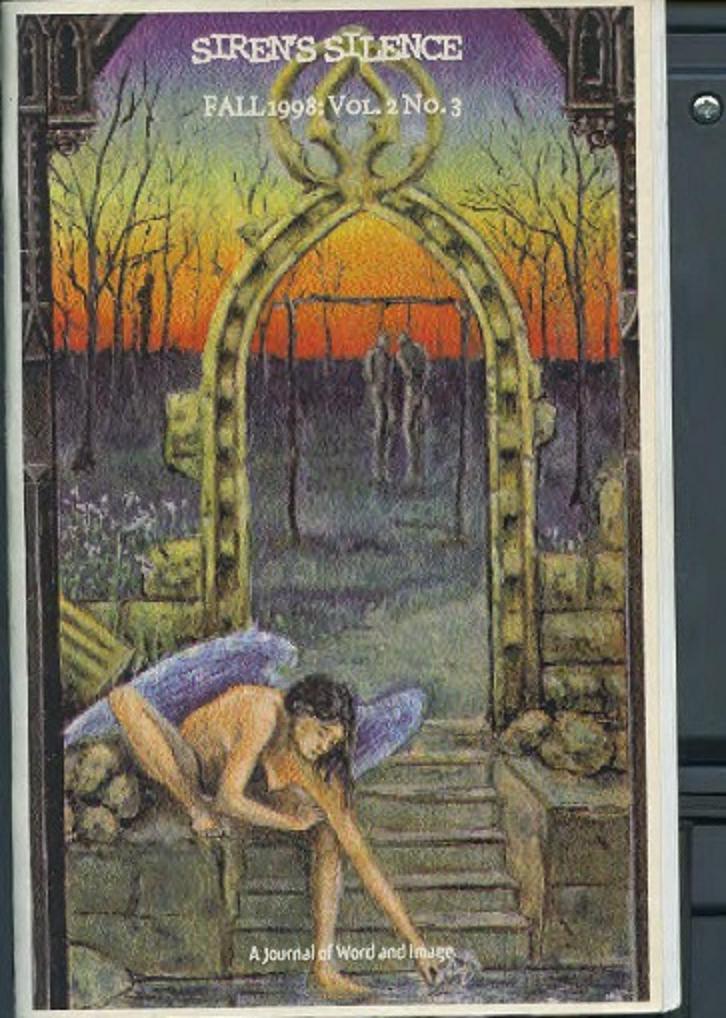
St. George's in Philadelphia, on 7th Street between South and Bainbridge, was a bar that had an upstairs which could be used as a performance space. One night in the late summer of '99, within a few days of shifting to Philadelphia from Manhattan (briefly stationed in Glenside before the move to 21st and Race), I got the tip-off that a bunch of acts were putting on a show at St. George's (I was at Philly Java). It was a sultry night, and cloudy, threatening rain. As I ascended the stairs, I looked and saw Matt Stevenson, who I had met at Robin's Books a little less than a year before at the last Siren's Silence reading, hunched over his keyboards/effects boxes rig, and Lora Bloom reciting into a microphone. This early, "pure" version of Radio Eris, as a duo, remains my favorite. Matt was short and stocky, 5'7, wore spectacles, had a slight hobble, and topped it off with a kind of inverse sartorial splendor, making semi-rags look as distinctive as possible. His speaking voice was rich and memorable, and he spoke quickly and articulately, even when stoned, which he often was. 

If I felt a certain urgency about talking to Matt at length for the first time, it is because an intuitive call had been sent out from somewhere in the universe to me Philadelphia was going to be a cultural monster, one way or another, and it was my responsibility (and Matt's, if he cared to join me) to start the ball rolling. This, I knew. I managed to convey this to Matt at the upstairs bar, and began to learn Matt's quirks even when he was deeply interested (and he was), Matt Stevenson had to be a cynical bastard. It's just that I had him, and I knew it. When we looked at what was happening onstage, it was obvious that magic was in the air— as Dave and Nemon Buckery played, the skylight above them was wild with windy rain and lightning, and the phantasmagoric effect was intense, the little crowd there assembled rapt. It spoke to me as a metaphor for what Philadelphia could be culturally, and it did so with the spacy, chiaroscuro, eerie ambiance of Philadelphia at night I was already familiar with.

Seemingly out of nowhere, Matt and I were joined by a third attendee. He introduced himself as Dan Baker, painter and musician. Dan was another lanky six-footer, with flaming red hair cut into a bob and a red beard to match. Dan was a transplant from Chicago, and (he implied instantly) underworld-consonant. You could feel the dangerous edges all around him. For all of Dan's musical involvements, with Dan (for me) the paintings are the point and, for their elegant simplicity, will eventually come to light. As I left St. George's that night, forced to walk to Market East Station (now Jefferson Station) sans umbrella, I felt something click that was like having a sudden million dollars in the bank. In the days that followed, I moved my stuff from Glenside to 154 North 21st Street. The flat was a studio but, because the front/facade of the apartment faced east (lots of morning sun) and was all bay windows, and the living room space had loft-level high ceilings, it felt loft-ish the right way. I was to live in "2A" until mid 2008, when I moved around the corner to 23rd and Arch.

I had Matt and Dan's contact info, and other things going on Jeremy Eric Tenenbaum and I were hosting readings in Philly Java's back-room, where the Siren's Silence readings had been in '96-'98. Jeremy and I, oddly enough, knew each other from earlier in the Nineties when, on semester breaks, I would hang out with Chris DeFranco in Manayunk, I met Jeremy and his Villanova-based "d" magazine posse. Jeremy's unique self-presentation Al Pacino channels Oscar Wilde, in Smiths-land and with a unique set of verbal tics, which manifested also in his work (both poetry and graphic design) was difficult to forget. The night of St. George's, I had probably started with Jeremy at Java before migrating over. Perhaps St. George's was not posh enough for Jeremy; I had (and have) a ratty streak, and no such scruples. In fact, Aughts Philly depended on most of us having a ratty streak most of the time. A perfect moment in Aughts Philly could happen anywhere, and we were all attuned to that wavelength.